
The Future of Policing: Navigating a Profession Under the Lens
In the early 2000s, I had the opportunity to speak to criminal justice students at colleges about what I believed would be the future of policing. At the time, many of my predictions seemed far-fetched. Smartphones were in their infancy, social media was not yet a dominant force, and the idea that nearly every citizen would carry a high-definition camera in their pocket was difficult to imagine.
One prediction, however, has become a defining reality of modern law enforcement:
Policing would become increasingly difficult due to the widespread use of video cameras and the public's tendency to view only portions of police encounters rather than the entire event.
Today, virtually every police interaction has the potential to be recorded. Body-worn cameras, dashboard cameras, surveillance systems, and citizen cell phones have transformed policing into one of the most scrutinized professions in society. Transparency is important and, in many cases, these recordings have protected both citizens and police officers. However, the challenge lies not in the existence of the cameras themselves, but in how the footage is often consumed.
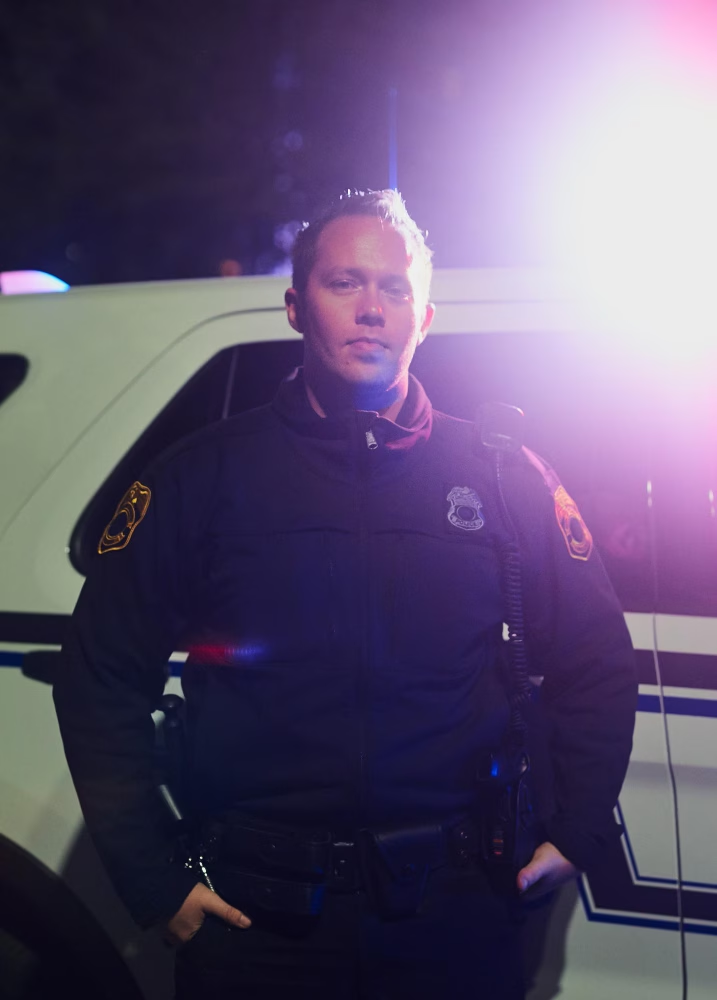
The Danger of the "Cut and Clip"
A thirty-second video clip rarely tells the complete story of a police encounter.
The public and media frequently see the conclusion of an event rather than its beginning. They may see an officer using force but not the preceding minutes or hours that led to that moment. They may see a suspect being restrained but not the threats, resistance, or rapidly evolving circumstances that required the officer to take action.
The context matters.
Law enforcement officers make decisions based on the totality of the circumstances, not on isolated moments captured at the end of an incident. When videos are edited, selectively shared, or viewed without context, they can create a narrative that does not accurately reflect reality.
This phenomenon has contributed to increasing public distrust and has placed enormous pressure on officers who, in the overwhelming majority of cases, are making difficult decisions in complex and dangerous situations.
The Reality of Decision-Making
Policing is unique because officers are often required to make life-changing decisions in seconds with incomplete information.
Unlike commentators who have the luxury of replaying a video frame by frame, officers do not have the benefit of hindsight.
An officer arriving at a call may know only what was relayed by a dispatcher, which can sometimes be incomplete, inaccurate, or rapidly changing. Every call has unknown variables.
A useful analogy is that of a traffic stop.
A traffic stop is like coming into contact with a can without a label.
You do not know what is inside until you open it.
The driver may be a mother taking her child to school. It may be an exhausted worker heading home after a long shift. Or it may be a wanted felon carrying a weapon, a person under the influence of drugs, or an individual determined not to return to jail.
The officer simply does not know.
Because of this uncertainty, officers must balance two competing responsibilities:
Maintaining officer safety.
Building and maintaining rapport with the public.
This balance has become one of the greatest challenges in modern policing.
Safety Versus Perception
Many police tactics that appear cautious or overly deliberate to the public are rooted in decades of hard lessons learned through tragedy.
Every year, officers are assaulted or killed during seemingly routine encounters. Many of those incidents began as simple traffic violations, suspicious person calls, or welfare checks.
As a result, officers are trained to approach every encounter with an appropriate level of caution. Unfortunately, this necessary caution can sometimes be perceived as distrust, aggression, or a lack of compassion.
The future of policing will require agencies to continue educating the public about why officers do what they do.
Understanding police tactics does not mean agreeing with every action taken by law enforcement, but it does create an environment where decisions can be evaluated fairly and with context.
The Impact of Social Media on Policing
Social media has fundamentally changed how information spreads.
An incident that once may have remained local can now become an international news story within minutes. A short video clip can generate millions of views before investigators have even completed their preliminary reports.
This creates significant challenges:
Immediate public judgment before all facts are known.
Increased stress and scrutiny on officers and their families.
Erosion of community trust when incomplete information spreads rapidly.
Pressure on agency leaders to respond before investigations are complete.
The future police officer must understand that every interaction has the potential to become public and that professionalism, communication skills, and emotional intelligence are more important than ever before.
The Officer of the Future
The successful police officer of tomorrow will need a diverse set of skills that extends far beyond traditional law enforcement training.
Future officers must become:
Exceptional communicators.
Skilled problem solvers.
Masters of de-escalation.
Technologically proficient.
Emotionally resilient.
Community focused.
Adaptable to constant public scrutiny.
At the same time, communities must recognize the realities of policing and appreciate the complexity of decisions officers make every day.
A Profession Worth Protecting
Despite the challenges, policing remains one of the most honorable professions in society.
Every day, officers answer calls for service not knowing what awaits them. They enter dangerous situations to protect people they have never met. They make split-second decisions with imperfect information while knowing that every action may later be judged by millions of people viewing a short video clip on social media.
The future of policing will undoubtedly continue to evolve. Technology will advance, transparency will increase, and public expectations will continue to change.
But one thing remains constant:
The vast majority of police officers are dedicated professionals who strive to make the best decisions possible under extraordinarily difficult circumstances.
As we move forward, our challenge is not simply to record police encounters—it is to understand them in their entirety.
The future of policing depends on our willingness to examine events from start to finish, to seek context before judgment, and to recognize the difficult balance officers must maintain between protecting themselves and preserving the trust of the communities they serve.
Only then can we build a future of policing that is both effective and worthy of public confidence.
About the Author
The founder of LEARN International brings a unique and uncommon perspective to the future of policing and public safety. His career has spanned nearly every facet of the criminal justice and public safety profession, providing him with an exceptional understanding of the challenges faced by law enforcement professionals both domestically and internationally.
He has served in corrections as an Operations Captain, Acting Deputy Warden, and Warden of a large correctional institution, overseeing complex security operations, crisis management, and the leadership of large teams in high-risk environments.
His law enforcement experience includes service as a police officer in one of the largest police departments on the West Coast, where he witnessed firsthand the evolving challenges facing modern policing, community expectations, and the increasing demands placed upon law enforcement professionals.
Beyond traditional policing and corrections, he has worked in special operations supporting the Department of Defense, contributing to mission planning, security operations, leadership development, and training in some of the world's most challenging environments.
His extensive international police training and advisory work provide a unique perspective on policing in high-risk and austere environments around the world. Working alongside foreign law enforcement agencies and public safety organizations, he has observed that regardless of geography, police officers face many of the same challenges: maintaining public trust, combating organized crime and human trafficking, responding to emerging threats, and making critical decisions with limited information and resources. These experiences have given him valuable insight into how policing is evolving globally and the importance of developing resilient, adaptive, and ethical leaders.
Perhaps most significantly, his perspective has been shaped by personal experience under extreme conditions. During his career, he has twice been classified as a hostage, experiences that reinforced the importance of leadership, resilience, decision-making under stress, and the human dimension of public safety.
These diverse experiences provide a rare and comprehensive understanding of the challenges facing today's law enforcement and public safety professionals. From correctional institutions and city streets to international training missions, special operations environments, and crisis situations, his career has been defined by one consistent principle:
Effective public safety depends upon courageous leadership, sound decision-making, and the ability to adapt to an ever-changing and increasingly complex world.
Through LEARN International, he continues to share these lessons with the next generation of law enforcement, corrections, military, and security professionals, preparing them to meet the challenges of the future with professionalism, integrity, and resilience.