
Distance Equals Time
Why Distance Is Critical During Encounters with Violent Subjects
One of the most important officer survival concepts taught in policing and security is simple:
Distance equals time, and time equals options.
Every year, police officers and security professionals are seriously injured or killed because a violent encounter closed to a distance where they had little or no time to react. While communication skills, de-escalation techniques, and defensive tactics are all essential, maintaining appropriate distance from potentially violent individuals remains one of the most effective ways to improve officer safety.
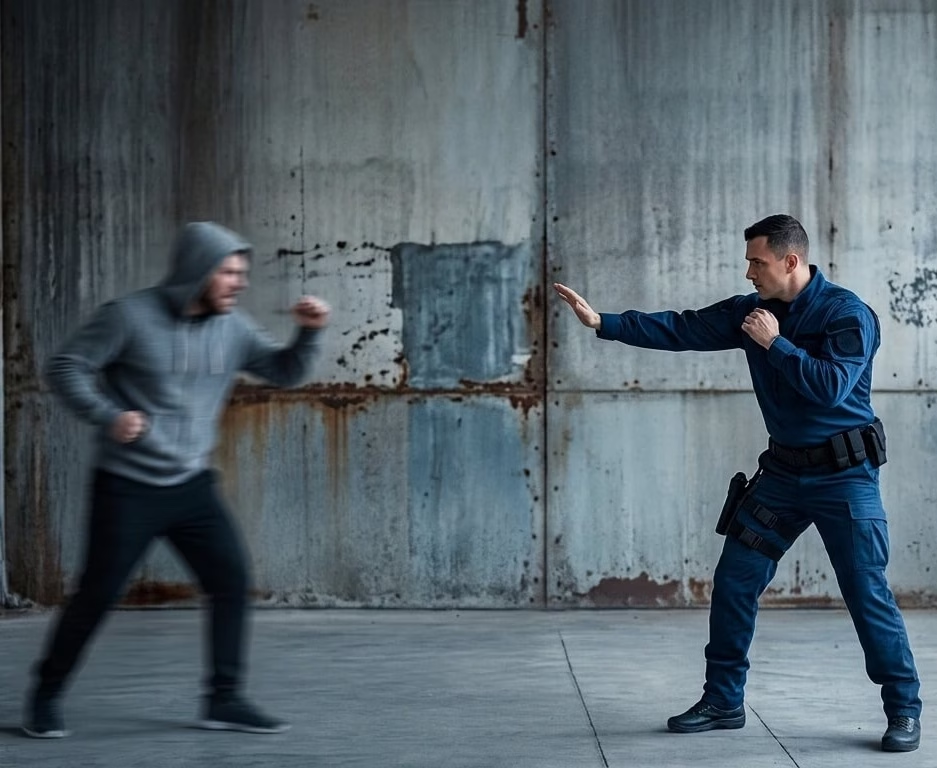
Why Distance Matters
Distance gives officers several critical advantages:
More time to recognize a threat.
More time to make decisions.
More time to communicate.
More time to access defensive tools.
More time to move, seek cover, or disengage.
More time for backup officers to arrive.
As distance decreases, reaction time decreases.
A suspect standing twenty feet away provides an officer significantly more options than a suspect standing two feet away.
Unfortunately, violent encounters often occur rapidly and at extremely close distances.
The Human Reaction Gap
Research in officer survival has repeatedly demonstrated that human beings require time to:
- Recognize a threat.
- Process information.
- Decide on a response.
- Physically react.
Even highly trained officers experience a delay between recognizing a threat and taking action. Under stress, that delay often increases.
Violent offenders exploit this reality.
Many attacks on officers begin with a suspect suddenly closing distance before the officer can react.
The Danger of the “Interview Position”
Many officers have become comfortable conducting contacts within arm’s reach of a subject. While this may seem natural during conversations, it places the officer at significant risk.
At close distances, a suspect can:
Throw punches.
Grab an officer’s weapon.
Produce a concealed knife.
Push the officer to the ground.
Strike with an improvised weapon.
The closer the officer stands, the less time they have to react.
Maintaining an appropriate reactionary gap provides a buffer that can prevent an assault from becoming a deadly encounter.
The Tueller Principle
One of the best-known concepts in officer safety is the “21-Foot Rule,” often referred to as the Tueller Principle.
In the early 1980s, Sergeant Dennis Tueller of the Salt Lake City Police Department conducted experiments to determine how quickly an individual armed with an edged weapon could cover distance.
His findings demonstrated that an average person could sprint approximately twenty-one feet in about one and one-half seconds.
The lesson was not that twenty-one feet is a magic number. The lesson was that an armed suspect can cover distance far faster than many officers realize.
The principle remains highly relevant today:
A suspect with a weapon can become an immediate deadly threat long before they physically touch an officer.
Distance Creates Tactical Options
When officers maintain distance, they create opportunities to:
De-escalate
Many emotionally disturbed or intoxicated individuals become more agitated when officers invade their personal space.
Use Cover
Distance allows officers to move behind vehicles, walls, pillars, or other protective barriers.
Deploy Less-Lethal Tools
Pepper spray, conducted energy weapons, and impact weapons generally require space to be used effectively.
Call for Backup
A few additional seconds may allow another officer or security professional to arrive and assist.
Make Better Decisions
Distance reduces panic and allows officers to evaluate options more effectively.
Security Officers Face the Same Risks
Security professionals often work alone and without immediate backup. They routinely encounter:
Shoplifters
Intoxicated patrons
Disorderly individuals
Mentally ill persons
Trespassers
Domestic disputes
A common mistake among security personnel is approaching too closely in an effort to gain compliance.
Professional security officers should remember:
There is rarely a tactical advantage to standing within arm’s reach of an agitated or potentially violent person.
Distance provides time and options.
Distance and Weapon Retention
Many officer assaults begin with attempts to disarm the officer.
The closer the suspect is to the officer, the easier it becomes to:
Grab a firearm.
Take a Taser.
Seize a baton.
Attack with a concealed weapon.
Maintaining distance dramatically reduces the opportunity for a suspect to gain control of an officer’s equipment.
Practical Officer Safety Tips
When dealing with potentially violent individuals:
- Maintain a reactionary gap whenever possible.
- Avoid standing directly in front of a subject.
- Keep your hands free.
- Position yourself so you can move.
- Identify cover and escape routes.
- Continuously assess the subject’s hands and body language.
- Do not allow unknown subjects to suddenly close distance.
- If a subject begins to close distance aggressively, recognize that this may be a pre-assault indicator.
The Bottom Line
Violent encounters happen quickly. Officers and security professionals seldom complain that they had too much distance from a threat. More often, they later realize they allowed a dangerous person to get too close.
Distance buys time.
Time creates options.
Options save lives.
Whether you are a police officer working the street, a deputy working corrections transport, or a security officer protecting a facility, one of the simplest and most effective survival tactics is maintaining a safe reactionary gap.
Never forget this officer survival principle:
Distance is your friend. Every foot you create may buy you the time needed to make the right decision and go home safely at the end of your shift.